
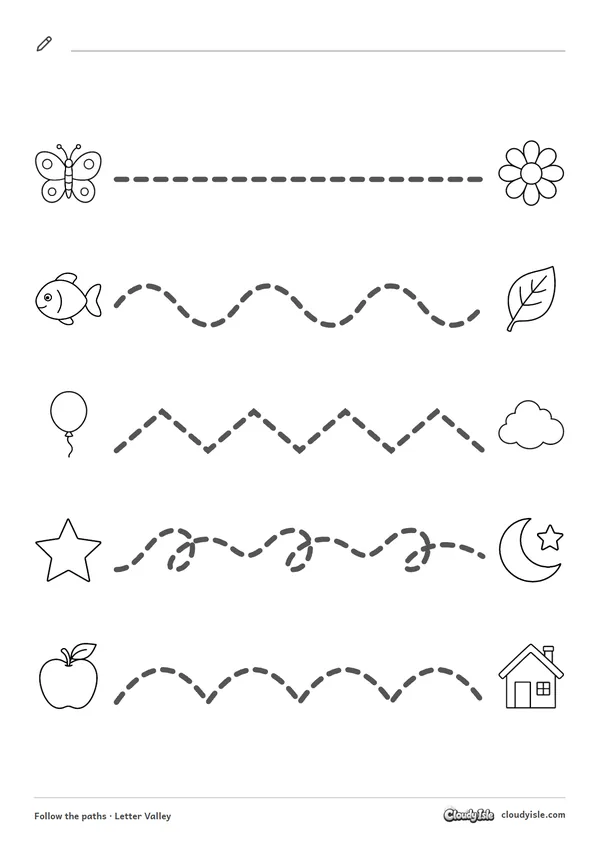
How to use this worksheet
Start with a finger: let your child trace each path in the air, then with a finger on the page, saying the shape aloud ("up and down, up and down" for the zigzag). Then take a chunky crayon and go from the left picture to the right one, without hurrying. Always start on the left; it is the direction we read and write in English.
The paths get trickier down the page. The loops in row four are the hardest, so it is fine to stop after two or three rows and come back later.
Why pre-writing lines matter
Letters are built from a handful of strokes: straight lines, curves, diagonals and loops. Children who have practised these shapes, in sand, with chalk, in paint and on paper, find letter formation much easier later. Hand strength and posture matter as much as the paper: play dough, tearing paper and climbing all help.
Our guide to pre-writing skills by age explains what to expect from two to five, and letter recognition activities is the next step.
Questions parents ask
Which pencil or crayon works best?
Chunky crayons, short crayons or triangular pencils are easiest for small hands, and short pieces encourage a more mature grip. A finger trace first, then a crayon, works well.
Should my child stay exactly on the line?
No need. Staying close to the path and moving smoothly from left to right is the goal. Accuracy improves with hand strength and practice.
Free for home and classroom use. Please share the link to this page rather than the PDF itself. Our guides for parents explain the skills behind each sheet.
More printables
Story pack · 5 min read
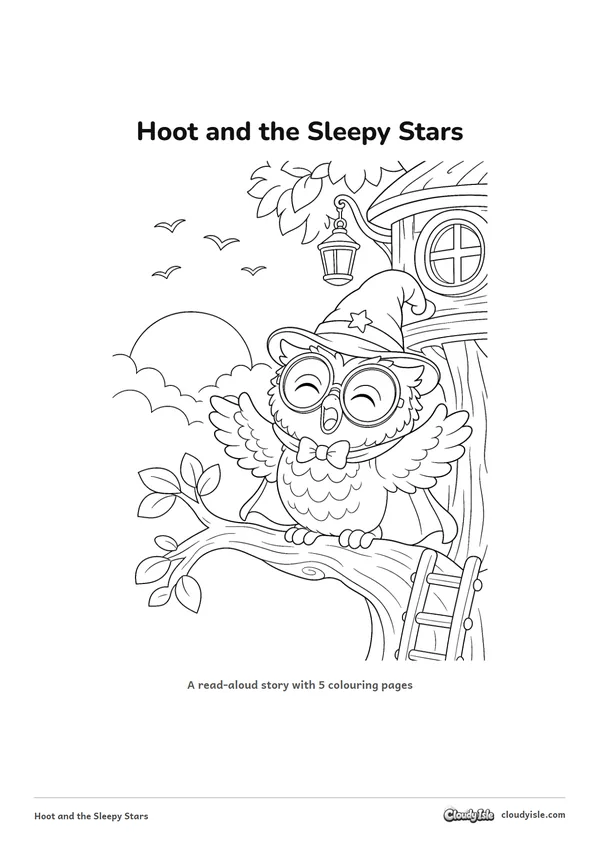
Hoot and the Sleepy Stars: A Free Bedtime Story to Read Aloud
A gentle five-minute story for grown-ups to read aloud at bedtime: Hoot the owl helps a little star who cannot sleep, with slow breathing, a quiet story and a cloud…
Story pack · 5 min read
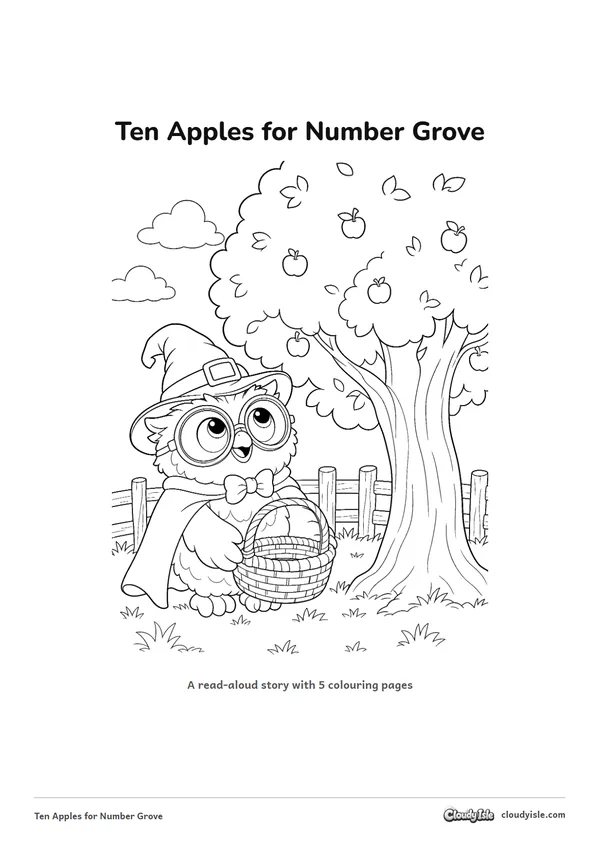
Ten Apples for Number Grove: A Free Counting Story to Read Aloud
A short counting story for grown-ups to read aloud: Hoot needs ten apples for a picnic, and his friends find them three, two and five at a time. Children count along…
Printable
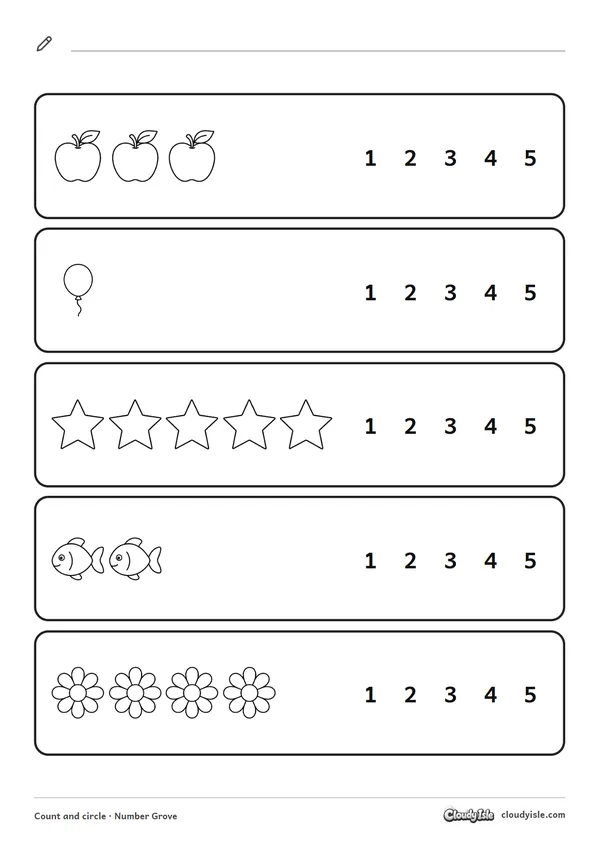
Count and Circle 1 to 5: Free Counting Worksheet
Five rows, five little pictures to count: apples, balloons, stars, fish and flowers, in groups from one to five. Your child counts each group, touching every picture…